CTFs
Welcome! This page showcases the Capture the Flag (CTF) competitions and cybersecurity challenges I’ve participated in.
National Cyber League Spring 2025 CTF
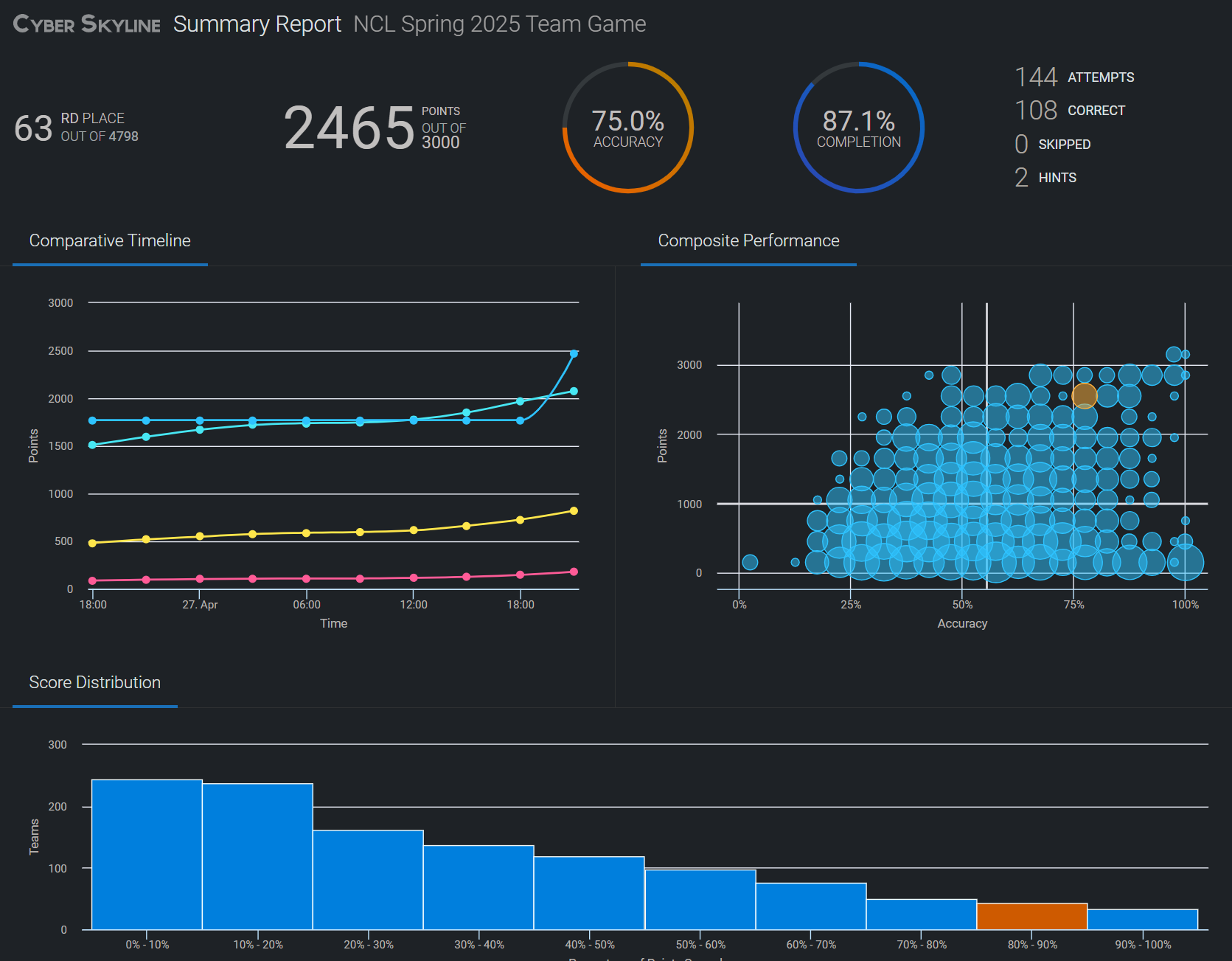
I competed with six other SANS classmates in the NCL Spring 2025 Team Game, placing 63rd out of 4,798 teams nationwide, ranking within the top 1.3% of all competitors. The CTF ran from Friday, April 25 through Sunday, April 27.
Throughout the event, I gained hands-on experience across several cybersecurity domains, including log analysis, network scanning and reconnaissance, network traffic analysis, password cracking, and more. I was able to apply many of the techniques I learned from SEC401 (GSEC) and SEC504 (GCIH).
Several key techniques and areas I focused on during this CTF were:
YARA Rule Development:
I wrote custom YARA rules to identify malware-infected files by detecting XOR decryption routines and other malicious attributes.
Advanced Nmap Scanning:
I researched and executed a variety of Nmap scans to discover services running on non-standard ports and evade firewall detection, including:
-
Source Port Manipulation with Decoy Techniques: nmap -sS -PN -g 80 -D RND:10 -T2
-
Packet Fragmentation and MAC Spoofing: nmap -sS -T2 -f -g 53 –spoof-mac 0
-
FIN and ACK Scan Techniques: nmap -sF nmap -sA
Fyodor’s book, NMAP Network Scanning, was invaluable in creating the Nmap scans.
Network Traffic Analysis and File Reconstruction:
I improved my Wireshark and TShark skills by solving network traffic analysis challenges, including analyzing .pcap files to:
- Apply protocol-specific filters to isolate pgsql traffic streams.
- Identify large Data Row responses.
- Reconstruct full application-layer payloads using Follow TCP Stream analysis.
Chris Sanders’ book, Practical Packet Analysis, was a great resource.
Manual Artifact Extraction and Recovery:
I recovered embedded files to solve this challenge by:
- Extracting raw hex-encoded payloads from network traffic.
- Normalizing data by removing
\xescape sequences usingsed. - Rebuilding binary files using
xxdto discover the password that unlocked a protected archive.
I look forward to applying these and other techniques in my home lab.